 Available
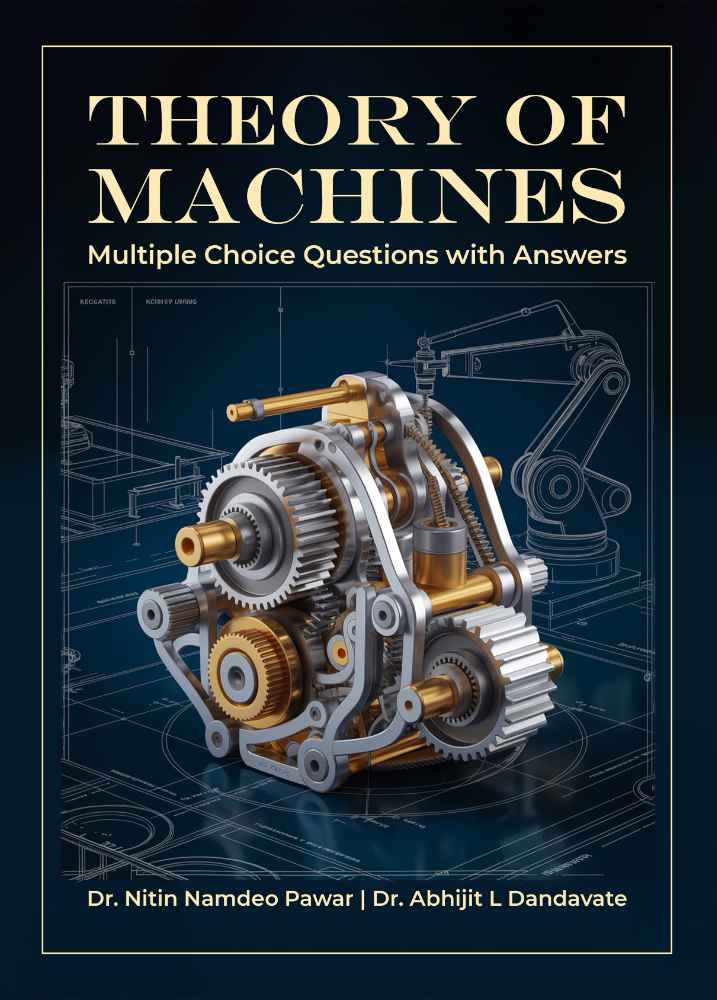
Theory of Machines
By Dr. Nitin Namdeo Pawar, Dr Abhijit L Dandavate
643.00
| SKU Code | Book2302475C |
| ISBN | 9788167450944 |
| Pages | 314 |
| Language | English |
| Genre | Technology |
| Book Type | Paperback |
| Book Size | 8*11 |
| Published Date | 10 October, 2026 |
Synopsis
"Welcome to “Theory of Machines for Competitive Examinations.” This book has been carefully designed to provide diploma students, undergraduate and postgraduate engineering students, researchers, educators, and competitive examination aspirants with a comprehensive understanding of the fundamental principles and applications of the Theory of Machines. It has been developed to serve as a reliable resource for mastering the concepts that are frequently tested in various national and state-level competitive examinations. As mechanical engineering continues to evolve with advancements in automation, robotics, manufacturing, and machine design, a strong foundation in the Theory of Machines remains essential for both academic success and professional excellence.
The Theory of Machines is one of the core subjects of mechanical engineering and forms the basis for understanding the motion, design, analysis, and performance of mechanical systems. It plays a vital role in the design and operation of engines, automobiles, manufacturing equipment, industrial machinery, robotics, and automated systems. Questions from this subject are consistently asked in competitive examinations such as GATE, Engineering Services Examination (ESE/IES), SSC JE, RRB JE, RRB SSE, State Public Service Commission examinations, ISRO, DRDO, BARC, BHEL, ONGC, HPCL, BPCL, IOCL, NPCIL, HAL, BEL, various PSU recruitment examinations, technical university entrance examinations, and other state and central government engineering recruitment tests. This book has been prepared with a clear focus on the syllabus and examination patterns followed in these competitive examinations.
The book systematically covers all major topics, including kinematics of mechanisms, inversion of mechanisms, velocity and acceleration analysis, cams and followers, gears and gear trains, governors, gyroscopes, balancing of rotating and reciprocating masses, flywheels, friction, brakes, clutches, belt and rope drives, chain drives, turning moment diagrams, vibrations, and other important concepts of machine dynamics. Every topic is explained using clear theory, engineering illustrations, solved numerical examples, shortcut methods, objective-type questions, previous examination trends, and conceptual discussions that strengthen analytical and problem-solving skills."
The Theory of Machines is one of the core subjects of mechanical engineering and forms the basis for understanding the motion, design, analysis, and performance of mechanical systems. It plays a vital role in the design and operation of engines, automobiles, manufacturing equipment, industrial machinery, robotics, and automated systems. Questions from this subject are consistently asked in competitive examinations such as GATE, Engineering Services Examination (ESE/IES), SSC JE, RRB JE, RRB SSE, State Public Service Commission examinations, ISRO, DRDO, BARC, BHEL, ONGC, HPCL, BPCL, IOCL, NPCIL, HAL, BEL, various PSU recruitment examinations, technical university entrance examinations, and other state and central government engineering recruitment tests. This book has been prepared with a clear focus on the syllabus and examination patterns followed in these competitive examinations.
The book systematically covers all major topics, including kinematics of mechanisms, inversion of mechanisms, velocity and acceleration analysis, cams and followers, gears and gear trains, governors, gyroscopes, balancing of rotating and reciprocating masses, flywheels, friction, brakes, clutches, belt and rope drives, chain drives, turning moment diagrams, vibrations, and other important concepts of machine dynamics. Every topic is explained using clear theory, engineering illustrations, solved numerical examples, shortcut methods, objective-type questions, previous examination trends, and conceptual discussions that strengthen analytical and problem-solving skills."
Reader Reviews (0)
No reviews yet. Be the first to write one!
Share Your Thoughts
Your personal identity metrics remain protected inside our system parameters.