 Available
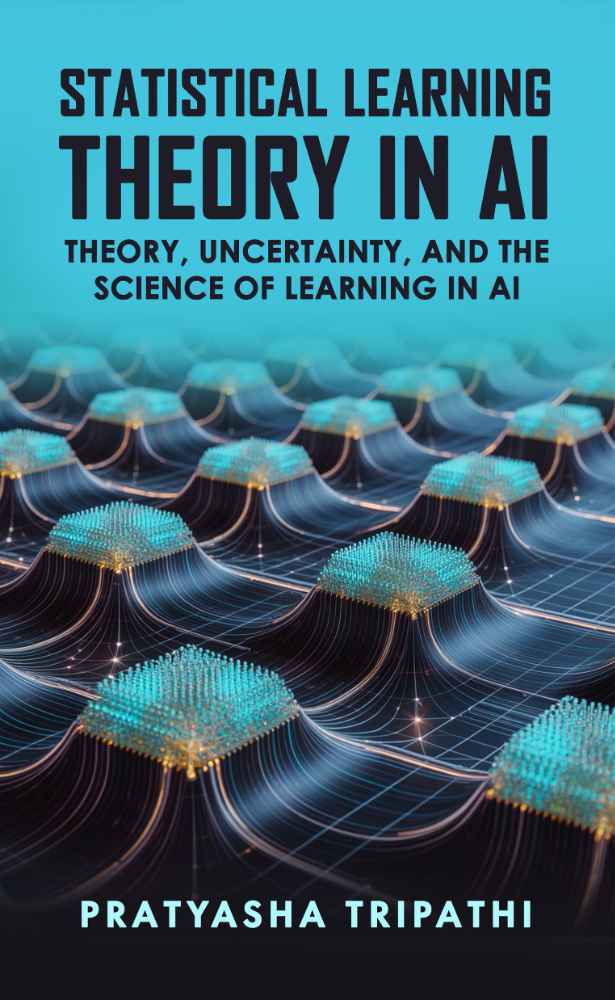
Statistical Learning Theory in AI
599.00
| SKU Code | Book2301961C |
| ISBN | 9789374245187 |
| Pages | 122 |
| Language | English |
| Genre | Science |
| Book Type | Paperback |
| Book Size | 5*8 |
| Published Date | 01 August, 2026 |
Synopsis
Statistical Learning Theory in Artificial Intelligence presents comprehensive and purely theoretical exploration of how learning from data is understood, analyzed, and controlled within modern Al systems. The book focuses on the fundamental principles that govern learning, emphasizing that artificial intelligence is essentially a process of inference under uncertainty rather than mere computation. a of Structured across six chapters, the book systematically develops the core ideas of statistical learning. It begins with the foundational concepts of learning, uncertainty, and inference, and then advances to the study generalization, overfitting, and the bias-variance trade-off. The discussion further extends to Vapnik-Chervonenkis (VC) Theory, which introduces a formal measure of model capacity, and Probably Approximately Correct (PAC) learning, which defines learning in terms of accuracy and confidence. The later chapters focus on regularization and optimization as mechanisms for controlling complexity, and finally synthesize these ideas within the context of modern artificial intelligence, addressing challenges such as high-dimensional data, robustness, fairness, and interpretability. A distinctive feature of this book is its emphasis on conceptual clarity and theoretical depth. Complex ideas are explained through intuitive reasoning, conceptual theorems, and graphical interpretations, avoiding heavy mathematical notation while maintaining academic rigor. This makes the book particularly suitable for postgraduate students, research scholars, and educators in statistics, data science, and artificial intelligence. The book not only explains how learning systems work but also provides insight into their limitations and potential improvements. By connecting classical statistical principles with contemporary AI developments, it offers a unified perspective that is essential for understanding and advancing intelligent systems in today's data-driven world.
Reader Reviews (0)
No reviews yet. Be the first to write one!
Share Your Thoughts
Your personal identity metrics remain protected inside our system parameters.