 Available
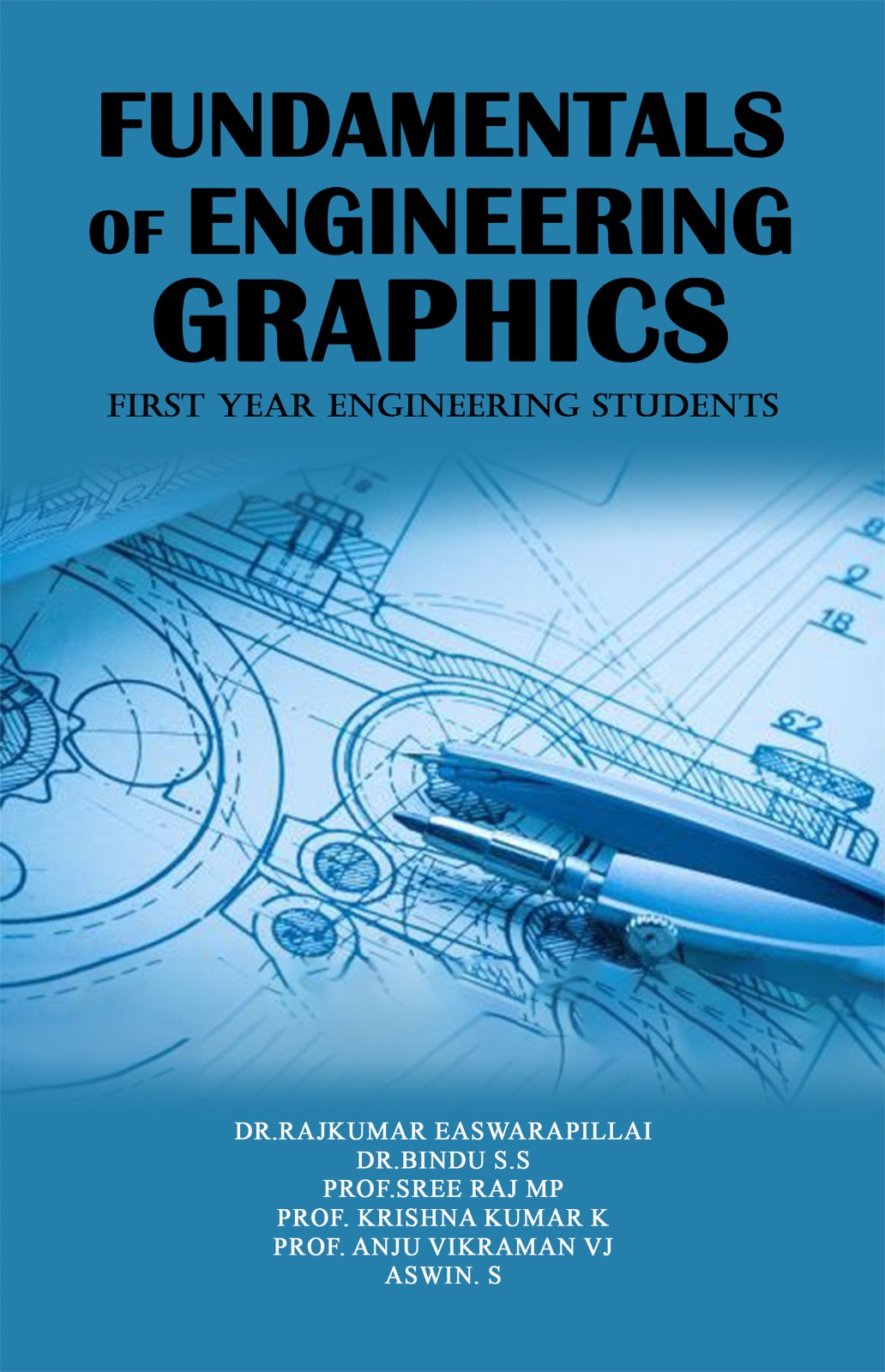
FUNDAMENTALS OF ENGINEERING GRAPHICS
526.00
| SKU Code | Book2301193C |
| ISBN | 9789374243060 |
| Pages | 296 |
| Language | English |
| Genre | Science Fiction |
| Book Type | Paperback |
| Book Size | 5.5x8.5 |
| Published Date | 20 April, 2026 |
Synopsis
This book covers the fundamentals of engineering drawing
and computer-aided design for first-year engineering
students. Engineering graphics begins with geometric
modelling basics, which provides the foundational principles
for representing objects. This starts with the simplest
element, the projection of points, and builds complexity with
the projection of lines, where their true length, inclinations,
and traces are determined. This extends further to
the projection of planes, analysing their orientation and size
in various views. These concepts culminate in the projection
of solids, where three-dimensional objects like prisms and
pyramids are depicted based on their position relative to the
reference planes. To understand internal details, the section
of solids is used, imagining the object cut by an imaginary
plane to reveal its interior cross-section. For fabrication
purposes, developments of surfaces are created, which are
the unfolded, flat patterns of all the solid's faces. To generate
a three-dimensional view on a two-dimensional
sheet, isometric projection is employed, using a specific set
of axes to convey depth and form without perspective.
Finally, these skills are applied to create clear and
accurate pictorial views of solids and objects, which are
essential for visualization, technical communication, and
manufacturing.
and computer-aided design for first-year engineering
students. Engineering graphics begins with geometric
modelling basics, which provides the foundational principles
for representing objects. This starts with the simplest
element, the projection of points, and builds complexity with
the projection of lines, where their true length, inclinations,
and traces are determined. This extends further to
the projection of planes, analysing their orientation and size
in various views. These concepts culminate in the projection
of solids, where three-dimensional objects like prisms and
pyramids are depicted based on their position relative to the
reference planes. To understand internal details, the section
of solids is used, imagining the object cut by an imaginary
plane to reveal its interior cross-section. For fabrication
purposes, developments of surfaces are created, which are
the unfolded, flat patterns of all the solid's faces. To generate
a three-dimensional view on a two-dimensional
sheet, isometric projection is employed, using a specific set
of axes to convey depth and form without perspective.
Finally, these skills are applied to create clear and
accurate pictorial views of solids and objects, which are
essential for visualization, technical communication, and
manufacturing.
Reader Reviews (0)
No reviews yet. Be the first to write one!
Share Your Thoughts
Your personal identity metrics remain protected inside our system parameters.